Dream Journal: How to Keep One and What to Write
A dream journal is the simplest way to stop dreams from disappearing. Here is what to put in it and how to use it after a month.
 Author: The DreamAI Team
·Published
·4 min read·👁 0 views

Table of contents
A dream journal is a simple thing that makes a big difference: it turns fleeting impressions into something you can return to. After a few weeks you start to see what repeats, which feelings accompany you at night and how your dreams change along with your life.
In this article we show how to keep a dream journal, what to write in it and how to turn your notes into a useful tool for reflection rather than a pile of entries no one reads.
In short: write quickly and without perfection, add feelings and tags, and once in a while review the whole thing. The value of a journal grows with every entry.
Why keep a dream journal
Dreams fade fast, and a journal gives them a second life. With it you can:
- keep the details that seemed obvious in the morning and are gone by afternoon,
- notice recurring themes: people, places, colors, situations,
- follow the emotions that return in your dreams over weeks,
- have your own source for reflection, conversation or prayer, if that matters to you.
A journal does not require believing in any particular theory of dreams. It is simply an archive of your nights.
What to write in a dream journal
There is no single template, but a few elements are worth always having:
- The date and possibly the time. This way you can see the rhythm and links with the events of the day.
- What happened in the dream. Even a few sentences. Write in the past tense and in your own words.
- The feelings. What you felt during the dream and after waking.
- People, places, colors, numbers. These are the elements that are easiest to search for and compare later.
- Your own associations. What does it remind you of? What does it connect to?
- Tags. Short labels such as “family”, “travel”, “water”, “work”.
In DreamAI all of these have a place: you can add the people and feelings from the dream, its colors, tags and your own interpretation.
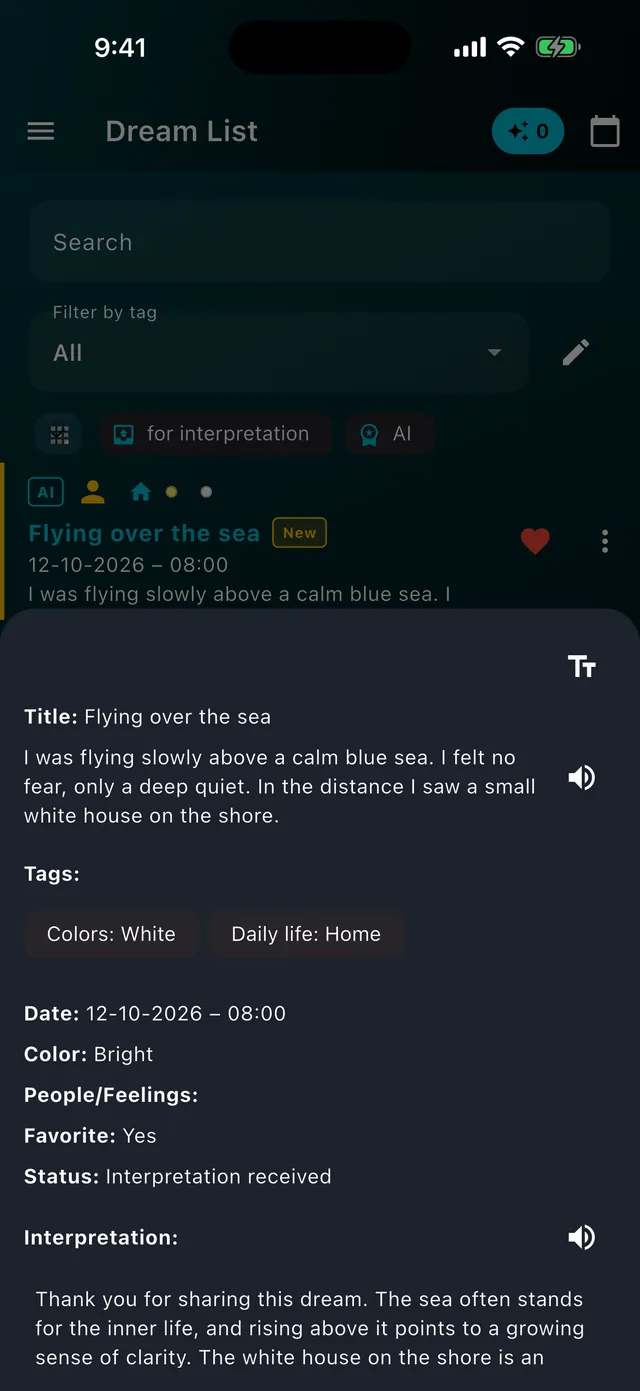
How to keep a dream journal without getting bored
The biggest enemy of a journal is perfectionism. A few rules help you keep it going:
- Write right away, even scraps. Details fade within minutes.
- Use your voice when you are sleepy. Dictating is faster than typing.
- Do not judge. A strange dream is still a dream. Do not be ashamed of anything, it is your private record.
- Set a fixed time, for example two minutes after waking, and a reminder on your phone.
- Reward the streak. A counter of consecutive days with a recorded dream can keep you motivated for longer.
How to read your journal after a month
The real value appears when you start to review your notes. Try this simple check-up:
- Filter your entries by a single tag and see in what circumstances it shows up.
- Check the most frequent keywords and tags in the statistics.
- Mark the favorite dreams you want to return to.
- Ask yourself: what surprises me most in these dreams?
In DreamAI the statistics show a dream calendar, day streaks and the most frequent keywords and tags, and the journal report (for the last month, six months, a year or the last 100 dreams) points out recurring themes, people, places and colors, the emotional tone and turning points.
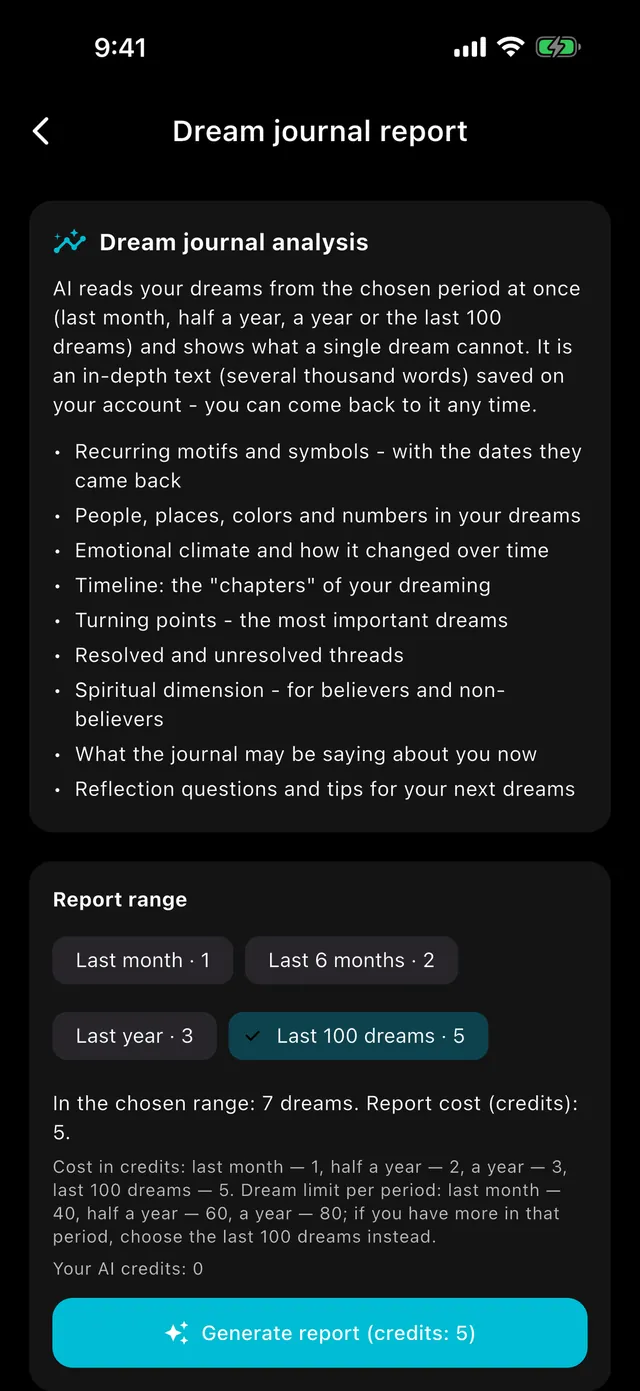
Privacy: what to keep in mind
A dream journal is a very personal record. Choose a tool that lets you stay private: the option to remain anonymous, a password lock and clear consent before any text is sent for analysis. In DreamAI the journal is saved on your device, and text goes to AI analysis only after you agree. The details are in the privacy policy.
Paper or an app?
A paper notebook has its charm and needs no battery. An app, on the other hand, offers search, tags, statistics, dictation, reminders, backup and the ability to listen to an entry read aloud. Many people start with one and move to the other. The best one is the one you will actually use every morning.
Frequently asked questions
Where do I start a dream journal?
With one sentence written right after waking. Do not plan the perfect structure, it will emerge on its own once you have a dozen entries.
How often should I write down dreams?
Ideally every time you remember anything. Regularity matters more than the length of a single entry.
Do I have to interpret every dream?
No. A journal is valuable on its own. Interpretation can be an extra rather than an obligation, and it always remains an inspiration for reflection, not a verdict.
Summary
A good dream journal is one you actually keep: quick to write in, private and easy to review. Start with one sentence, add feelings and tags, and after a month look at the report and statistics to see what returns in your nights.
If you are looking for a place for such notes, check out DreamAI for iPhone, Android and Windows. How to remember more dreams is covered in How to remember your dreams: 9 practical ways.
The DreamAI Team
Makers of the DreamAI app
The Dream Apps team behind the DreamAI app. We write about remembering dreams, keeping a dream journal and how technology can support reflection on your own dreams.
The view and like counters work without cookies and without storing IP addresses. We only use a short-lived, anonymized hash so the same visit is not counted repeatedly.
Keep reading

How to Remember Your Dreams: 9 Practical Ways
A dream can vanish within minutes of waking. Here are nine simple habits that help you catch it before it slips away.

Can AI Interpret Dreams? What AI Dream Analysis Offers
AI cannot predict the future from a dream, but it can help you look closely at its text, symbols and emotions. Here is what to expect.