How to Remember Your Dreams: 9 Practical Ways
A dream can vanish within minutes of waking. Here are nine simple habits that help you catch it before it slips away.
 Author: The DreamAI Team
·Published
·5 min read·👁 0 views

Table of contents
You wake up with the feeling that something important was just happening, and a few minutes later only a fog is left. If you wonder how to remember your dreams, the good news is that it is a skill you can train. You do not need tricks, only a few simple habits and a place to write down what you remember.
In this guide we share nine ways that help with remembering dreams, explain why dreams fade so quickly and show how to make it part of your daily routine.
In short: a dream is easiest to catch in the first minutes after waking. Write it down right away, even in fragments, and do it regularly. You will remember more with every week.
Why dreams fade so quickly
Most of us know the feeling: a dream was vivid, and by the time you get out of bed it dissolves like steam over a mug. Dreams are fleeting because once you wake up, the stimuli of the day take over your attention: light, sounds, thoughts about plans and duties. If you do not hold on to a dream right away, your mind simply has no reason to keep it.
That is why advice on how to remember your dreams always starts with the first minutes. The whole art is to make room for the dream in the first minutes after waking and to write down at least a fragment. The rest is about regularity.
How to remember your dreams: 9 ways that work
1. Set an intention before sleep
Before you fall asleep, tell yourself briefly: “I will remember my dream in the morning.” It sounds trivial, but it points your attention at that goal. Many people notice that simply deciding to keep notes increases the number of dreams they remember.
2. Keep your phone or notebook within reach
If writing down a dream means getting out of bed and looking for a pen, you probably will not do it. Put what you use right next to your bed. In DreamAI you add a new entry with one tap, and the journal’s home screen shows your latest dreams, symbols and revelations.

3. Do not move right away
After waking, stay a moment in the same position with your eyes closed. A sudden move, reaching for a phone full of notifications or thinking about the morning’s tasks quickly washes out the details. First go back in your mind to the last scene, then to the earlier ones.
4. Write in fragments, do not wait for the full story
You do not need a whole, coherent dream. Write what you have: a person, a place, a color, a sentence that was said. One fragment often opens up the rest once you start writing. A perfect description is not the goal, a trace is.
5. Dictate instead of typing
When you are sleepy, typing can be tiring. Dictating a dream by voice is faster and keeps up with your thoughts. In DreamAI you can record a dream by voice and turn the recording into text, then listen to it read aloud later.
6. Write down feelings, not only events
The emotions from a dream often last longer than the plot. Add what you felt: fear, calm, curiosity, shame. After a few weeks these notes show you what keeps returning and help when you read your dreams in a wider context.
7. Take care of regular sleep
Tiredness, irregular hours and cutting nights short make remembering harder. A steady bedtime, a calm evening and avoiding large amounts of alcohol before bed are simple conditions that usually improve the quality of the night, and so dream recall.
8. Set a gentle alarm and a reminder
A harsh alarm can erase a dream in a second. Choose a soft tone and set a reminder to record your dream. In DreamAI you can turn on reminders so you do not forget the journal.
9. Go back to your notes and tag them
A dream that is recorded but never read loses half its value. Once in a while review your entries, add tags and colors and mark favorites. With search and filters you can easily find a specific dream, and the journal report shows recurring themes.
How to build the habit in two weeks
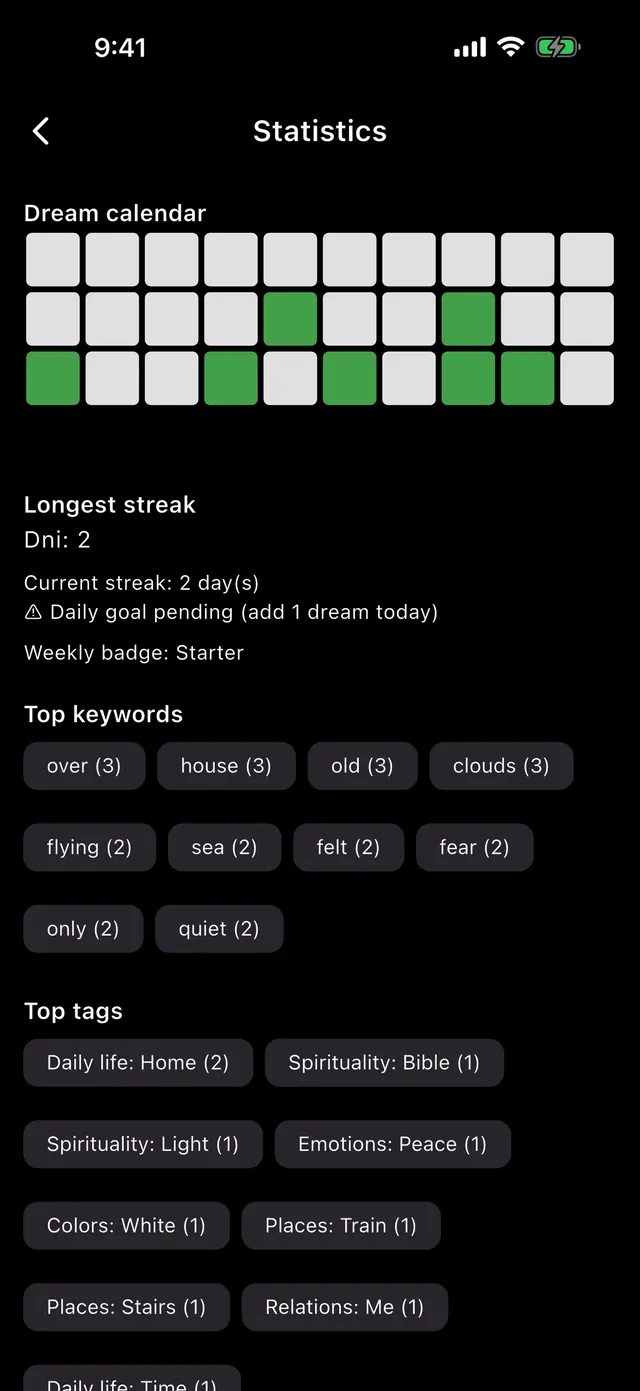
The best way to learn how to remember your dreams is to practice a little every day. Do not try to change everything at once. For the first few days focus on one thing: write down anything right after waking, even one sentence. In the second week add dictation and emotions. In the third, review your entries and tag them. A gradual change is easier to keep than an ambitious plan you drop after three days.
A daily goal helps too: in DreamAI the statistics show a streak of consecutive days with a recorded dream, which gives a small but effective boost.
Frequently asked questions
Why can’t I remember my dreams?
Most often the reason is that after waking your attention jumps straight to the day’s matters and the dream is not captured. Staying still for a moment, a notebook by the bed and regular sleep all help. If a problem with memory or sleep is persistent, it is worth talking to a doctor.
Does everyone dream?
According to sleep researchers, practically all healthy people dream, but not everyone remembers their dreams. Not remembering does not mean there was no dream.
How long does it take to learn to remember dreams?
It is very individual. Many people notice an improvement after a few weeks of regular note-taking, but the pace varies and depends on sleep quality and consistency.
Summary
If you want to know how to remember your dreams, start with the simplest things: a phone or notebook by the bed, a few minutes of stillness after waking and writing down even scraps. Add emotions, regular sleep and reviewing your entries, and after a few weeks you will see that you remember more and more.
Want everything in one place? Try DreamAI: a private dream journal with dictation, tags, statistics and read aloud. You can read more about keeping notes in Dream journal: how to keep one.
The DreamAI Team
Makers of the DreamAI app
The Dream Apps team behind the DreamAI app. We write about remembering dreams, keeping a dream journal and how technology can support reflection on your own dreams.
The view and like counters work without cookies and without storing IP addresses. We only use a short-lived, anonymized hash so the same visit is not counted repeatedly.
Keep reading

Dream Journal: How to Keep One and What to Write
A dream journal is the simplest way to stop dreams from disappearing. Here is what to put in it and how to use it after a month.

Can AI Interpret Dreams? What AI Dream Analysis Offers
AI cannot predict the future from a dream, but it can help you look closely at its text, symbols and emotions. Here is what to expect.